

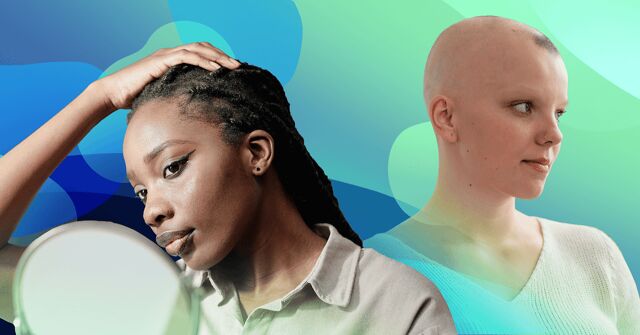

More Than Hair Loss: Navigating the Mental and Physical Journey of Alopecia

When I was a senior in high school in 2011, I first noticed a small round bald patch on the crown of my head. Alopecia is likely genetic in my family, and so the feeling I most felt was dread. I knew from my family members’ experiences that alopecia is a challenging and unpredictable condition.
While perhaps the hair loss would end with a small and coverable spot, I knew it could also result in a years-long tumultuous journey. In fact, my life with alopecia is now almost as long as my life without it.
It has not been easy, but the experience has also shown me that I am far more resilient than I ever realized, and it has demonstrated the unconditional support I have from my family and friends. For that, I have to be grateful.
My first dermatologist appointment
Upon discovering the first bald spot in high school, I immediately made an appointment with a dermatologist. Unsurprisingly, he quickly confirmed a diagnosis of alopecia areata simply through visual inspection. We began treatment via steroid injections, which went on for several months.

Fortunately, I am a millennial, and side-parts have always been in for us! Parting my hair to the right helped me cover up the spot. The steroid spots took a long time to kick in, and honestly, I’m not sure if they actually worked for me, or if the hair spontaneously regrew.
For the next several years, spots occasionally appeared and disappeared without treatment. I got more used to finding spots and creatively covering them, but I always understood that the situation was tenuous.
Stress and its effect on alopecia
Unfortunately, I lost all of the hair on my body very quickly in April 2020, at the height of the COVID-19 pandemic. Often, alopecia patients blame their hair loss on periods of intense stress, and of course, the pandemic was highly stressful to all of us.
However, my alopecia had never correlated to episodes of intense stress that had occurred previously in my life. What triggered my progression to alopecia universalis remains a mystery to me.
An event that brought some awareness
The two biggest changes to my life as an alopecia patient both happened in the span of a few months in 2022. In March of 2022, many of us recall Will Smith punching Chris Rock at the Oscars over a joke made about Jada Pinkett-Smith’s alopecia. I don’t condone violence, but I also didn’t think the joke was funny. It was a really unfortunate situation.
However, it did get people talking about alopecia. Previously, whenever I decided to share with someone that I had alopecia, I had to define the condition for them. Now, I could say, “You know what Jada Pinkett-Smith has?” It made conversations easier, because people could see that it was a sensitive and difficult condition, and they supported me accordingly.
Starting a medication
The second change happened in June of 2022. The FDA approved the first JAK-inhibitor medication to treat alopecia. I was intrigued, but I did not begin treatment immediately. My dermatologist explained the JAK-inhibitor's side effects. Also, my dermatologist had never treated an alopecia patient with that type of medication, and was hesitant to do so.
It was actually my primary care physician who helped frame the decision for me. “This is a quality of life issue for you,” she told me, after I explained through tears how much I wanted my hair back. “It may not work for you, but you deserve to try to be happy.”
I was fortunate to then find a deeply intelligent and empathetic dermatologist who helped me better understand the risks and benefits. I have been treating my alopecia with JAK-inhibitors for over two years now. I am extremely fortunate that I have not experienced any side effects.
I now have my eyelashes and eyebrows back
However, I have not regrown all of my hair, and I still wear a wig. For me, the decision has been worth it. Personally, the most challenging aspect of losing my hair was losing my eyebrows. I know it may sound ridiculous to some. Eyebrows are two very small features of one’s body. But losing them made me feel unrecognizable to myself. The JAK-inhibitor has regrown my eyebrows and eyelashes, and for that, I am extremely thankful.
Whether or not it fully regrows my hair, I consider it a success.
Alopecia is as much a mental journey as it is a physical one. A supportive set of family and friends and a knowledgeable medical team can truly make all the difference. My best advice is to get the support you need, ignore comments and suggestions that aren’t helpful, and make whatever decisions feel most comfortable to you.
No one can tell you how you should live your alopecia journey. I only hope that reading mine has helped you understand that you are certainly not alone.
Join the conversation