

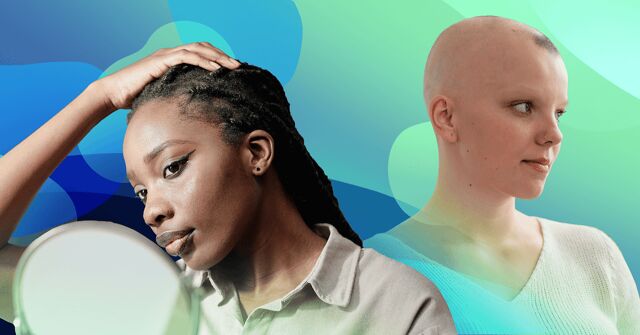

Navigating Privacy With Alopecia

When I was first approached about writing articles about my alopecia journey, my first question was “Can I write under a pseudonym?" I was eager to share my alopecia journey in the hopes that someone reading my work will find my story to be helpful. At the same time, I am careful about choosing when and how I share my diagnosis with others. In this article, I want to share how I have made those decisions in my life and some tips for navigating those potentially challenging conversations.
There is no wrong way to approach your alopecia diagnosis
Going bald, wearing a head scarf or bandana, or wearing a wig are all intensely personal decisions. However, I have found that the desire to conceal one’s hair loss and maintain privacy can come with its own stigma.
People may assume that the desire for privacy results exclusively from crippling insecurity. Alopecia is not shameful, and it is not something anyone should feel pressure to hide from others. On the other hand, it is a mentally challenging condition, and often misunderstood by others. Seeing myself with patchy hair loss, and especially seeing myself go completely bald, was unsettling to me. I simply didn’t feel like myself.
Since the beginning of my alopecia journey, I have hid my alopecia from the general public, first through specific hairstyles, then topical hair fibers, and eventually high-quality human-hair wigs made to look as close as possible to my natural hair. I have also worn temporary tattoo eyebrows when experiencing eyebrow loss. I have to admit, I never mastered fake eyelashes, but I have found that with some strategic eyeliner application, that is the least noticeable type of hair loss.

Keeping things private has its own cost
I made the decision not to reveal my alopecia publicly because sometimes revealing one’s alopecia diagnosis can lead to unhelpful or even hurtful unsolicited comments. While most of the time people are sympathetic, sometimes people will encourage you to just embrace your baldness, or will offer you advice on unproven medical interventions to regrow your hair, or will remark on how they knew you were wearing a wig, but didn’t say anything. I have found it is more comfortable for me to reveal my alopecia diagnosis to trusted individuals and on an as-needed basis.
The people who know the most about my alopecia journey are my immediate family and closest friends. It is important to have people in your life who can support you, and I am incredibly grateful to my family and friends for the care they have shown me over the 15 years that I have had alopecia.
I share my alopecia diagnosis with all medical providers
Especially since I am now taking a JAK-inhibitor medication, it is important that every medical professional I interact with is aware that I have an autoimmune disorder. I also openly share my diagnosis in situations where wearing my wig isn’t feasible or comfortable, such as when getting a massage. Every professional I have interacted with has been courteous and understanding of my alopecia diagnosis.
Sharing while dating and working
The biggest concern I have faced has been in revealing my alopecia diagnosis to people I have dated. I am a woman who dates men, and I have worried that the men I have dated would find my wig-wearing to be deceitful or off-putting. I typically choose to wait until a few dates into the relationship to reveal my alopecia because it’s important to me that the other person gets to know me as a person first. When I share my alopecia diagnosis, I try to just be factual, simply saying, “I have an autoimmune condition called alopecia that makes my hair fall out, and I wear wigs.”
I sometimes add that while it is not necessarily a secret, it is private. Fortunately, the most common reaction I receive is, “Okay, that’s fine. Thanks for telling me.” The first time I ever told a guy I was dating that I had alopecia, I was truly terrified. It turns out, it’s not nearly as big of a deal as I expected, and while it’s never my favorite conversation to have, I no longer dread it.
The most significant choice I have made is not to reveal my alopecia diagnosis to my employer or coworkers. Work is an area of my life where my alopecia diagnosis has nothing to do with how well I can do my job. I enjoy the freedom to simply forget about this part of my life while I am working.
You don't have to justify your decisions
If you’ve decided to share your alopecia journey with others, know that you are entitled to your own decisions, and that you don’t have to justify them to anyone. I have found it is helpful to preface conversations, whether you are looking for advice or just a listening ear. If you receive an unsolicited comment about your alopecia, it is okay to simply say, “I’m not interested in talking about that,” and remove yourself from the situation.
It can also be helpful to talk to a mental health professional if you are struggling with your alopecia. Talking about your alopecia can be challenging, so any conversations should always be on your terms.
Join the conversation