



My Experience With Stage 4 Advanced Metastatic Cancer & Palliative Chemotherapy

If you’re starting chemotherapy, I wanted to share my experience in the hope that it might ease some of your anxiety. I remember how daunting it felt before my first treatment, and hearing what someone else has been through can sometimes make things feel a little less frightening.
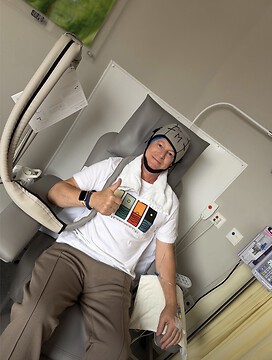
I’d like to focus first on the dreaded ice cap - feared by many, myself included, and my experience with it so far.
To be completely honest, it has been okay. Bearable and, thankfully, nowhere near as bad as I had imagined. Let me tell you what’s involved and how I’m coping with it.
The cold cap is fitted before chemotherapy, remains in place during the infusion and is usually kept on for a while afterwards. It cools the scalp, constricting the blood vessels beneath the skin. This may reduce the amount of chemotherapy reaching the hair follicles and help limit hair loss for some people. It doesn’t guarantee that hair will be preserved, and its effectiveness depends on the drugs, the cooling system and the individual.
A picture of me with mine on is at the bottom of this story. Yes, I know I look ridiculous - and I’m getting increasingly worried when people tell me it suits me!
The first 10–15 minutes were pretty grim. I had that strange feeling of panic and just wanted it off. But I stuck with it, and after about 15 minutes I could barely feel it.
I wear mine for 30 minutes before chemo and 20 minutes afterwards, keeping it on throughout the infusion.
Everyone reacts differently, of course. But if you’re trying the cold cap for the first time, don’t assume those first few minutes are how it will feel for the whole session.
If you can, stick with it. It does get easier.
I’m doing it to help myself, not because I’m vain. I just like looking in the mirror and seeing me, rather than being constantly reminded of cancer.
At a recent session, two nurses said they should try it one day to see how uncomfortable it is. It was kind of them, as I knew they were thinking it might help them empathise with patients undergoing this particular form of torture. There is something lovely about healthcare professionals wanting to understand, even in a small way, what their patients are going through. They already do so much, but that willingness to empathise means a lot when you’re the one sitting in the chair.
On the evening of my second session, I was honestly heard saying, “I’ve really enjoyed today,” before remembering I’d had chemo that morning!
But that’s genuinely how I’d felt. Honestly, my chemo days are… okay.
Looking back, it could have been because I was the centre of attention, It could have been the lovely nurses chatting away about anything and everything to keep my mind off what was happening. It could have been my lovely partner, who, as always, was there to support me.
Or it could simply have been the chicken tikka in pitta with a chocolate bar - my three-weekly treat!
Whatever the reason, it reminded me that a chemo day doesn’t have to be entirely defined by chemotherapy.
All I’m saying is that chemo sucks and the ice cap is ‘challenging’, but it’s worth remembering the good they’re doing. It’s a positive step and a chance not to feel like the victim patient, but to kick the s### out of the cancer.
So, if you’re starting out, be kind to yourself. You don’t have to feel brave every minute, and you don’t have to pretend that any of this is easy. Take it one appointment, one hour and, sometimes, one minute at a time.
There may be difficult days, but there may also be moments of laughter, kindness, comfort and unexpected normality. Hold on to those moments when they come.
You are not just a patient sitting in a chair. You are still you - and you don’t have to face this alone.
So, if you’re starting out: you’ve got this.
Join the conversation