



The Little Things

In the ICU, everything feels urgent.
There are monitors sounding, medications to give, assessments to complete, procedures to coordinate, and numbers that can change in an instant. When so much attention is focused on keeping a patient stable, it can be easy for the little things to feel insignificant.
But sometimes, the little things aren’t little at all.
During one of my ICU stays, my arm began itching underneath my hospital identification bracelet. Compared with everything else happening at the time, an itchy wrist didn’t exactly seem like an emergency.
But I spoke up
My nurse was incredibly busy, but he listened. Instead of simply moving the bracelet or dismissing the irritation as something minor, he stopped and thought about how to solve the problem.
He created a customized skin-protective barrier using compression hose layered with mesh. It kept the hospital bracelet from touching my skin while still allowing the barcode to remain visible and scannable. That mattered because the bracelet wasn’t just identification. It was part of the hospital’s safety system, used to verify my identity for medications, procedures, transportation, and other aspects of my care.
He found a solution that protected both my skin and my safety.
Then he went one step further
He photographed what he had created and documented it so that the nurses caring for me afterward would know how to recreate it.
Later, we discovered that I had developed an allergy to the material in the hospital bracelets.
That experience taught me something important about self-advocacy: speak up about the little things.
Tell your healthcare team about the new itch, lump, bump, scrape, pain, rash, or change you’ve noticed. You don’t have to determine whether it’s medically significant. That’s what your healthcare team is there to help evaluate.
Our job as patients is to communicate what we’re experiencing.
And when someone listens, something else happens.
Trust begins to grow.
For a few minutes that day, I wasn’t simply a patient in an ICU bed surrounded by equipment and numbers. I was a human being whose discomfort mattered to another human being.
That connection works in both directions
We often talk about healthcare professionals empowering patients. They educate us about our conditions and medications. They teach us how to manage symptoms, make informed decisions, advocate for ourselves, and hopefully live better lives.
But I think we talk far less about the ways patients can empower healthcare professionals.
Before becoming a patient, I worked in healthcare. I know there are patients healthcare workers never forget. Sometimes a conversation, a breakthrough, a thank-you, a laugh, or simply knowing you made a difference becomes the thing that carries you through an exhausting shift.
The patient may never know it.
They may never realize that their interaction happened on a day when that nurse, doctor, respiratory therapist, CNA, technician, or other healthcare professional was exhausted, discouraged, burned out, or quietly wondering whether they could keep doing the job.
S
ometimes healthcare providers remind patients why they keep fighting
And sometimes patients remind healthcare providers why they chose to care for people in the first place.
That nurse and I still cross paths at the hospital. Because I unfortunately spend more time there than I’d like, we’ve become what I jokingly think of as “hospital buddies.” When I saw him again recently during another difficult visit, my spouse and I were genuinely happy to see him, and he was happy to see us.
That relationship began with something as simple as an itchy arm.
That’s why I don’t think the little things in healthcare are really little.
When patients speak up and healthcare professionals listen, we aren’t just exchanging medical information. We’re building trust. We’re seeing the person behind the patient wristband and the person behind the badge.
And in those moments, we have the opportunity to empower one another.
Sometimes the most meaningful part of healthcare isn’t found on a monitor.
Sometimes it’s found in the moment when two people remember that they’re both human.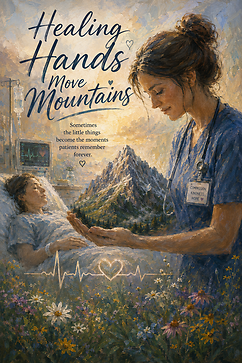
Join the conversation